Energía Renovable
Transforming Biomass into Sustainable Energy
Technical systems
Real-time operation
9 MW
Installed electrical generation capacity
50 t/h
Nominal industrial steam production
100%
Renewable source based on forest biomass
9 MW
Installed electrical generation capacity
50 t/h
Nominal industrial steam production
100%
Renewable source based on forest biomass
Sustainable energy for national industry
Technical Specifications
Engineering Data
- Steam pressure: 67 bar(a)
- Steam temperature: 490 °C
- Heating surface: 2,000 m²
- Feedwater: 105 °C
- Balanced draft system
Thermal Components
- Double-pass superheater
- Optimized convective bundle
- Economizer module
- Air preheater
- Advanced thermal performance
Environmental Objectives
- Emission reduction
- Sustainable use of biomass
- Energy optimization
- Smaller carbon footprint
- Green energy production
Our commitment
Bi-Drum Water-tube Boiler
The Bi-Drum water-tube boiler constitutes the core of the plant's steam generation process. Designed to operate with biomass as a renewable fuel, it produces high-pressure superheated steam that drives the turbine and supplies industrial processes. Its natural circulation and thermal recovery technology maximizes energy efficiency and ensures safe, reliable, and sustainable operation.
50 t/h
Nominal steam capacity
66 bar
Operating pressure
450 °C
Steam temperature
2,000 m²
Heating surface
| Parameter | Specification |
|---|---|
| Type | Bi-Drum Water-tube, vertical furnace |
| Steam capacity | 50,000 kg/h |
| Operating pressure | 66 bar(a) |
| Steam temperature | 450 °C |
| Feedwater temperature | 105 °C (demineralized) |
| Total heating surface | ≈ 2,000 m² |
| Draft system | Balanced — forced draft + induced draft |
| Fuel | Quebracho colorado residue (50% moisture) |
| Fuel moisture in boiler | Reduced to 10% prior to combustion |
Thermal Engineering
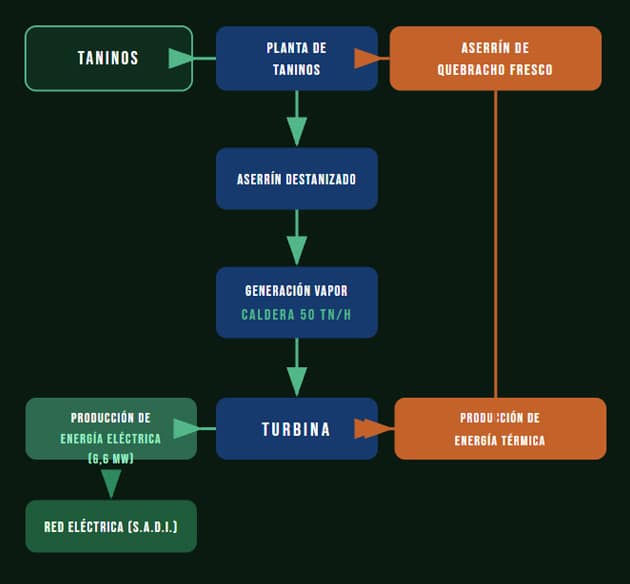
The boiler integrates heat recovery technologies that allow maximum utilization of the energy generated during combustion. The superheater, convective bank, economizer, air preheater, and flash steam recovery system work in an integrated manner to improve thermal efficiency and optimize biomass consumption.
Biomass Combustion
Biomass is automatically transported from the silo to the boiler via a hydraulic feeding system. Inside the furnace, reciprocating grates control the fuel's movement to ensure uniform, efficient combustion with low emissions. The released heat transforms water into superheated steam, which will be used to produce electrical energy and process steam.
Steam Turbine
9 MW
Nominal generation capacity
12 barg
1st steam extraction
1.5 barg
2nd steam extraction
WEG
Coupled electrical generator
- High efficiency
- Operational Reliability
- Automation and Control
Lubrication System
Vacuum and Condensation System
Demineralization Plant
- Clarification
- Ultrafiltration
- 03. Reverse Osmosis (Double Pass)
- Continuous Electro-Deionization (CEDI)
Renewable Fuel
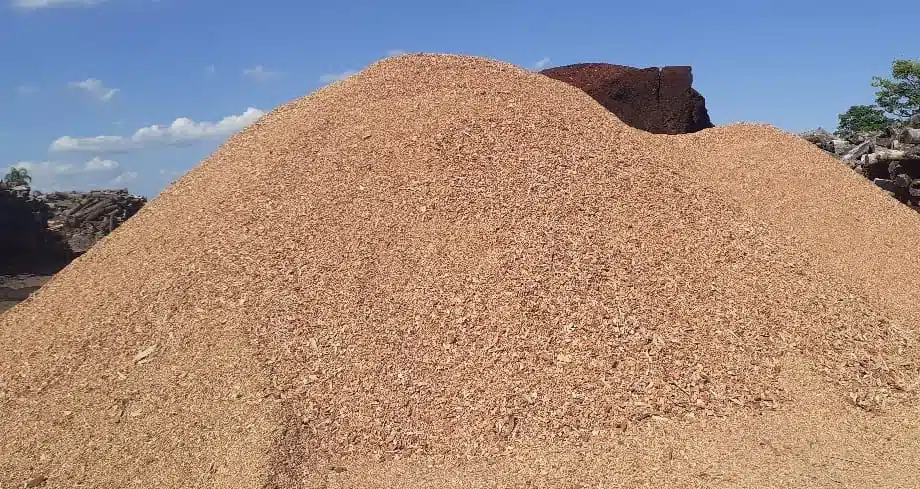
Destannified Quebracho Colorado
CO₂ Neutral
- CO₂ Neutral Balance
- Circular Economy
- Water Saving ~10%
| Characteristic | Detail |
|---|---|
| Type of biomass | Spent detanninized quebracho colorado sawdust |
| Origin | Discard from the industrial process of tannin extraction |
| Moisture at origin | 50% |
| Pre-combustion moisture | Reduced to 10% |
| CO₂ Balance | Neutral — carbon cycles by photosynthesis |
| Self-sufficiency | Yes — energy surplus available for grid |
| Effluent reuse | Yes — factory cooling system |
| Water saving | ≈ 10% of total consumption |